
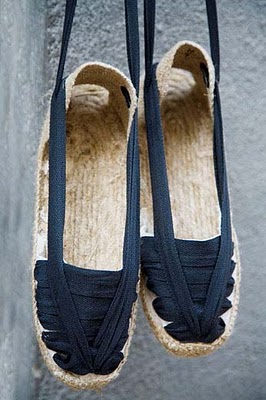
It's light, environmentally-friendly, authentic, natural: The espadrille is the shoe of the moment. Many menswear labels are making them for next year so why don't you buy a pair now? The term espadrille is
French and derives from
the Catalan name for the shoes,
espardenya, which derives from the Catalan name for
esparto, a tough, wiry
Mediterranean grass used in making rope.
Espadrilles have been made in
Catalonia since the 14th century at least, and there are shops in
Spain still in existence that have been making espadrilles for over a century.

The
Museo Arqueológico Nacional has in its collection a grass-soled sandal said to be 4,000 years old, which looks very like the classic espadrilles made in Catalonia for at least five centuries. Traditional espadrilles have a canvas upper with the toe and vamp cut in one piece, and seamed to the rope sole at the sides. Often they would have laces at the throat that would be wrapped around the ankle to hold the shoes securely in place. Early espadrilles were worn by both men and women.

Once peasant footwear, espadrilles have grown in popularity, especially now. Espadrilles can now be found designed by top designers (...and Zara). Most are manufactured in
Bangladesh and
Spain.

Bangladesh is the producer of high quality jute, and has become a manufacturing centre for premium jute soles and complete espadrilles. Ninety percent of the world's total production of espadrilles, as well as jute soles, is now manufactured in Bangladesh, although some manufacturers in Europe import jute soles from Bangladesh to finish espadrilles in their home countries.

If you’re in Barcelona, buy them at
La Manual Alpargatera, a workshop established in the early 1940s, which supplied
Salvador Dalí with his favourite pairs in black or white canvas (if not,
Pierre Hardy makes some mouth-watering ones for
Hermes). Dalí’s friends and contemporaries –
Picasso, Chanel, Colette – also made espadrilles stylish, wearing them with white cotton trousers, sailor tops and an a deep tan.


 "There is a lot of wild in the city. My eye has become attuned to the plant life that pushes and grows its way through all the cracks in the concrete. Once you have noticed it, it's everywhere." - Anna Garforth
 She also used trash to produce this artwork: "We worked with second year graphic design students to create a word communicating the medium. The medium was trash, the word we chose was used.A weeks worth of rubbish was collected by the students and turned into a typographic piece."
 This "leaf typography" is a site specific piece and 100 per cent bio degradable using thorns and fallen leafs.

 There are many more ideas, just visit her website: http://www.crosshatchling.co.uk







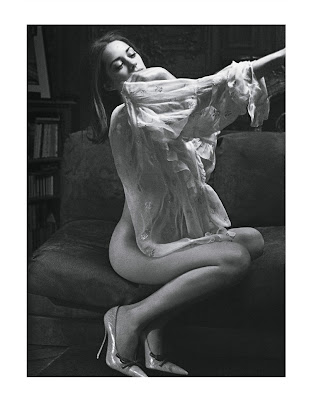 The photos are by Mikael Jansson, half of it passable (nice cover), half of it truly banal.


_01.jpg)
